The government has adopted an amendment to the Energy Law, which does not introduce a technological revolution, but changes the rules of the game for companies using energy and planning investments in RES. This is a moment when inaction starts to cost more than an imperfect decision. New regulations streamline access to power, connections, and infrastructure, which means that companies acting reactively will increasingly
The government has adopted an amendment to the Energy Law, which does not introduce a technological revolution, but changes the rules of the game for companies using energy and planning investments in RES.
This is a moment when inaction is starting to cost more than an imperfect decision. The new regulations streamline access to power, connections, and infrastructure, which means that companies acting reactively will have less and less room to maneuver.
For businesses, this is not a topic "to read," but to consider in the context of their own energy model.
Why the need for change arose
The Polish grid connection system has been operating in overload mode for years. Issued connection conditions often "reserved" capacities on paper, without real investments on the other side. The effect?
– hundreds of gigawatts of formally blocked capacity,
– long connection queues,
– lack of predictability for business,
– growing risk to system stability.
The amendment is intended to address this problem. Its goal is not to accelerate RES "at all costs," but to streamline the process, which in its current form has ceased to be functional.
What the amendment changes in practice, not in headlines
The most important change concerns the logic of connections, not the technologies themselves. The legislator is trying to move away from the "first come, first served, blocks capacity" model towards a more selective and realistic approach.
In practice, this means, among other things:
– limiting long-term "holding" of connection conditions without investment realization,
– greater pressure to transition from preliminary agreements to actual connection agreements,
– changes in fees and rules designed to discourage purely speculative projects,
– greater flexibility in how existing connections are used.
The latter is particularly important for industrial companies.
Why does this matter now?
Because the new rules reward projects that are decisionally ready, not those that are just "sounding out the topic." Access to power, connection flexibility, and the ability to combine sources will increasingly depend on the quality of the project, not just the application.
Cable pooling and energy storage are a signal, not a revolution
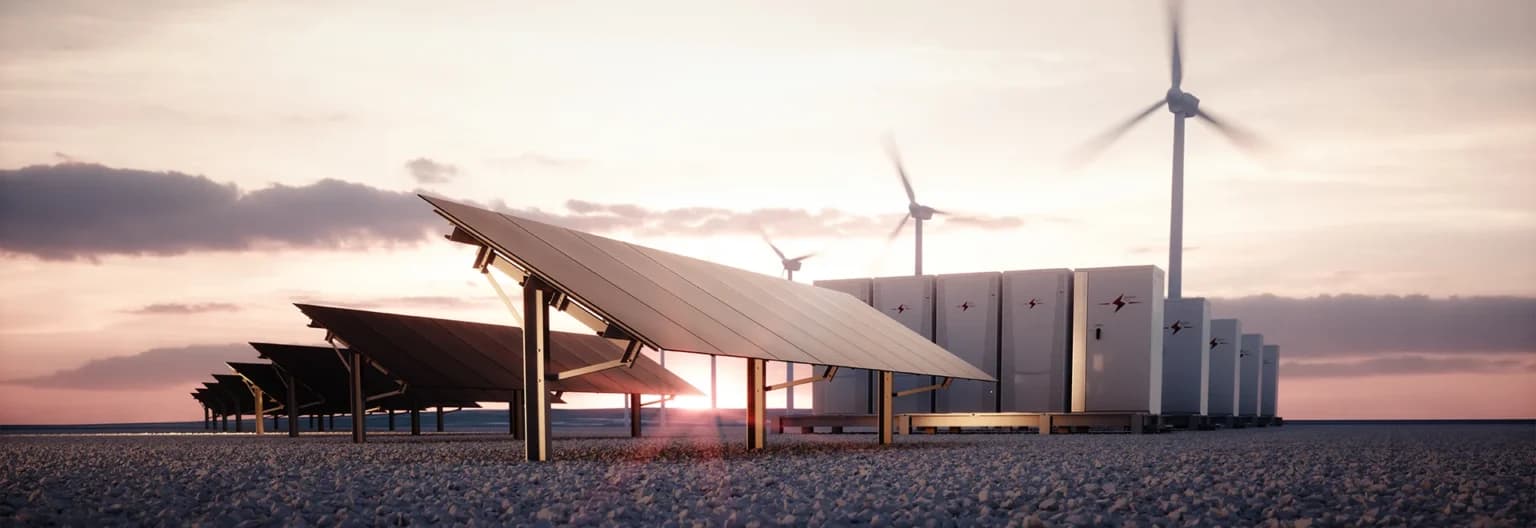
One of the more frequently commented elements of the amendment is the facilitation of connection sharing (so-called cable pooling) and the opening of the system to energy storage as an element of grid infrastructure, not just an "add-on to RES."
This is not a technological revolution, but rather a formal signal that the system is beginning to catch up with what the market has been doing for a long time:
– combining different sources and consumers within a single connection point,
– using energy storage for power stabilization, not just self-consumption,
– designing installations as a whole, not a collection of independent devices. This is good news for businesses, but only on one condition: the project must be well-thought-out from an energy perspective, not assembled "under the law."
This is a moment when energy storage ceases to be an add-on "for later" and begins to play the role of a decision-making tool.
Companies that can already combine sources, consumers, and storage into one system will have a real advantage in the new regulatory environment. Others will wait.
Why part of the industry criticizes the changes
Not all voices from the market are enthusiastic. Criticism mainly concerns the fact that the new regulations:
– raise the entry threshold for smaller, poorly prepared projects,
– force greater financial and technical maturity from investors,
– limit the room for maneuver for projects based solely on reserving "spare" capacity.
From a systemic perspective, it is difficult to consider this a disadvantage. It is rather a shift of the market from the declaration phase to the implementation phase.
What this means for industrial companies
For energy-consuming enterprises: production plants, logistics centers, large commercial facilities, this change has one common denominator – energy is no longer just a cost, but becomes a decision-making area.
The new regulatory environment rewards those who:
– understand their consumption profile,
– can control power,
– combine sources, storage, and consumers into one system,
– make decisions based on data, not declarations.
Without energy management systems and a coherent technical project, even the best regulations will not translate into real benefits.
In practice, this means one thing: the time for passive market observation is over.
Even if a company is not planning investments this year, the lack of an energy concept will increasingly be a barrier to connections, capacity expansion, or discussions with the grid operator.
What this means for company decisions and why now
The amendment to the Energy Law does not simplify energy investments.
It makes postponing decisions increasingly costly.
Companies that today:
– do not have a clear picture of their power and consumption profile,
– do not know what role energy storage can play,
– do not treat EMS as a decision-making tool,
will act reactively, under pressure from the operator, deadlines, and power availability.
This is the moment when it is worth considering not "whether to invest," but in what energy model the company wants to operate in the coming years.
Technius supports businesses in translating regulatory changes into concrete scenarios:
what makes sense, where the real limitations are, and what decisions are worth making sooner, before they are forced.
Schedule a consultation and see how these regulations translate to your company.
About Technius
We help companies cut energy costs — from audits and analyses to deploying energy storage and EMS systems. Our team has delivered hundreds of projects, saving clients millions of zloty.
Meet us